On-prem WebRTC analysis: the answer used to be no
Self-hosting rtcStats used to mean self-hosted collection with hosted analysis. Since v1.9, the rtcstats-enrichment server runs the analysis engine inside your own network.
September 17, 2026
Learn how to troubleshoot WebRTC applications, monitor real-time communication performance, and get the latest insights on WebRTC development and debugging. Here we'll also share the latest improvements delivered in the new releases of rtcStats.
Self-hosting rtcStats used to mean self-hosted collection with hosted analysis. Since v1.9, the rtcstats-enrichment server runs the analysis engine inside your own network.
rtcStats v1.10 rebuilds the session charts for calls that run for hours, adds 11 new connectivity and audio observations, and expands the documentation area.
WebRTC observability gets used as a synonym for dashboards and for getStats() access. Here is the requirements list: the six things a system has to capture before it can tell you why a call went bad.
Voice AI evals score the STT-LLM-TTS pipeline. Two transport failures leave no mark in a transcript, and full duplex removed the slack that hid them.
rtcStats v1.9 brings self-hosted enrichment via the rtcstats-enrichment server, four new observations, and a new Open Source section in the Knowledge Base.
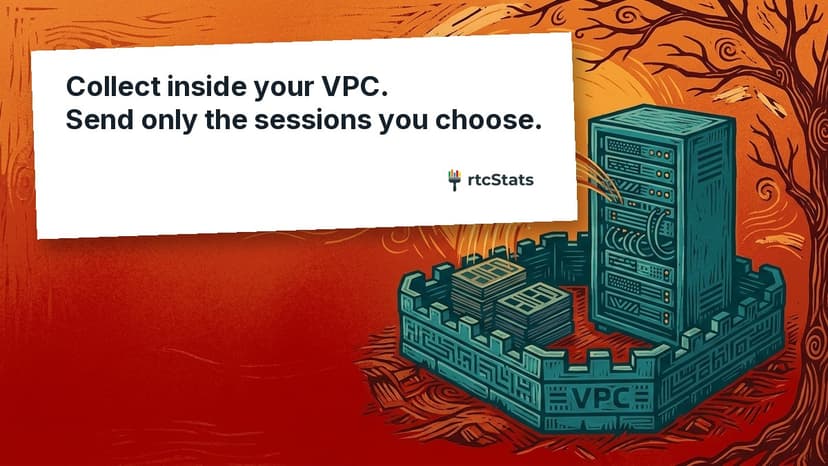
rtcStats collects WebRTC session data inside your infrastructure with rtcstats-server. Forwarding to rtcstats.com is off by default. You choose what leaves your VPC.
You pull the webrtc-internals dump and scroll thousands of getStats() lines. rtcStats reads it for you, keeps its analysis engine portable, and lets your data stay yours.
rtcStats v1.8: Dark and Light themes, a redesigned Overview with min/max, P95 and standard deviation, and Streams timelines anchored to call start.
Stop scrolling through thousands of getStats lines. Upload a webrtc-internals dump to rtcStats and AI tells you what went wrong on the call in under 30 seconds. Or query it from Claude Code and Cursor over MCP.
rtcStats v1.7: a client-focused Devices page with summary widgets, a dedicated api.rtcstats.com host with an observations catalog, and smoother onboarding.
Compare Chrome's webrtc-internals with rtcStats. See when browser-level debugging is enough and when production WebRTC monitoring gives you the missing data.
Version 1.6.0 revamps the Analysis page with new stat cards and filters, brings rich filters to the public API and MCP, and adds deeper peer connection security visibility.
Version 1.5.0 brings server geolocation in connectivity diagrams (rtcstats), a refreshed website with Open Source and Resources pages, and new observations.
Compute Pressure is the browser's privacy-preserving CPU load signal. Here's what it means, how to use it, and how rtcstats-js already collects it side-by-side with your other WebRTC metrics.
Version 1.4.0 adds an embeddable viewer, compute pressure insights, new API endpoints, a broader knowledge base, and a revamped trial for all new accounts.
Version 1.3.0 introduces the Experience Score, six new connectivity observations, observation tag clouds, a richer overview, visual quality timelines, and Chrome 146 compatibility.
Version 1.2.0 introduces API access with Application Tokens, a revamped Knowledge Base, session tags and descriptions, new observations, and smarter AI summaries powered by Claude Sonnet 4.6.
Version 1.1.0 introduces the Showcase with YouTube integration, 5 Gold Credits for new accounts, and new connectivity observations.
Stop asking users to capture webrtc-internals manually. Use rtcstats-js with IndexedDB to store WebRTC stats locally and get dumps only when you need them.
Version 1.0 introduces AI call summaries, expanded observations, infrastructure detection, UI polish, core fixes, and rtcStats-js 2.1.0.
Advanced CPU observations, enhanced video & network transparency, uniform design across all screens, and improved upload monitoring.
Public sharing feature, three essential network observations, comprehensive Knowledge Base overhaul, improved chart tooltips, and UserAgent consistency fixes.
Redesigned Streams and Connections pages with deeper insights, integrated Knowledge Base, enhanced pair timelines, and new network observations.
Meet Observations: a set of best practices that see WebRTC issues before you do, saving you time so you can focus on what matters most.
Complete revamp of charts component with themed grouping, expanded connectivity observations, and new audio MOS aggregation.
Discover the 'less is more' approach to WebRTC monitoring: collect everything but focus on what matters most for faster troubleshooting.
Complete redesign of the Internals page into focused panes, new connection setup observations, and improved user experience.
Learn how to build your own WebRTC monitoring solution with rtcstats. Control costs, own your data, and customize your metrics collection.
New audio troubleshooting features, enhanced connection analysis, and team collaboration tools to improve your WebRTC debugging experience.
A field guide to chrome://webrtc-internals: how to open it, what every section shows, which metrics explain a bad call, and how to save a dump file.
Stay up to date with the latest rtcStats releases and discover new features designed to enhance your WebRTC debugging experience.

Discover why server-side monitoring isn't enough for WebRTC and how device-side statistics collection can transform your user experience.
Browse articles by category

